
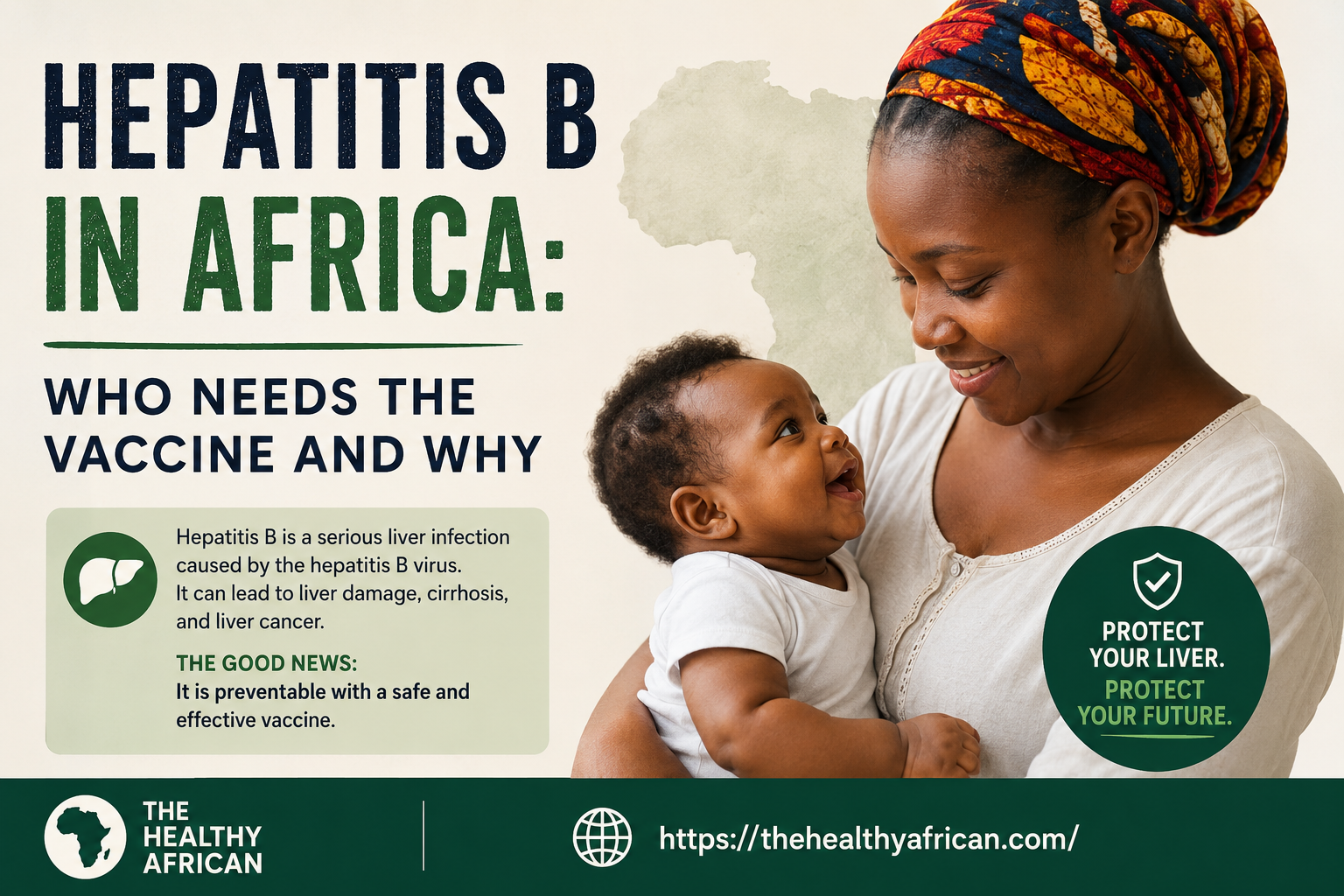
Imagine carrying a virus that quietly destroys your liver for two or three decades without a single noticeable symptom, until the damage is too severe to reverse. For most of the estimated 82 million people living with hepatitis B (HBV) in the WHO African Region, that is exactly what happens. HBV is the leading cause of liver disease, cirrhosis, and primary liver cancer across the continent, and in most cases, the person carrying it has no idea.
Africa accounts for roughly 63% of all new hepatitis B infections in the world every year, according to a 2024 WHO analysis. In Nigeria alone, an estimated 14.4 million people were living with chronic HBV in 2022, based on a general population prevalence of 5.4%. Across the WHO African Region, 18 of 47 countries have general population prevalence above 8%, the threshold for high endemicity. A safe, effective vaccine has existed for over 40 years. The challenge is not a lack of science, but a persistent gap in coverage and awareness. This article explains who is at risk, what the vaccine does in your body, and what action to take today.
What hepatitis B does to the body
Hepatitis B is a viral infection that targets the liver. Once inside the body, the virus replicates in liver cells and triggers inflammation that can last a lifetime if unaddressed. The WHO describes two forms: acute HBV, a short illness usually cleared by adults, and chronic HBV, a lifelong condition most common in people infected as newborns or young children.
Age at infection is the key factor. Up to 90% of newborns who contract HBV at birth will develop chronic infection if they do not receive vaccination promptly. By contrast, only about 5% of adults newly infected will go on to develop chronic disease. This biology is why Africa carries such a disproportionate burden: the virus enters communities during the most vulnerable period of life.
Chronic HBV silently damages the liver over years and decades. Research suggests people with untreated chronic infection face a lifetime risk of between 15% and 40% of developing cirrhosis or hepatocellular carcinoma (primary liver cancer). In most African settings, liver cancer is diagnosed late, when curative options are already out of reach.
How hepatitis B spreads
In sub-Saharan Africa, the dominant transmission route is from mother to child during delivery, and through horizontal transmission in early childhood via close contact with an infected household member. This differs markedly from high-income countries, where HBV spreads mainly among adults through unprotected sex and shared injecting equipment. Research in The Lancet Gastroenterology & Hepatology links this pattern to the failure of perinatal prevention programmes across the region.
Beyond mother-to-child transmission, HBV also spreads through:
- Unprotected sexual contact with an infected partner
- Needlestick injuries and blood exposure in healthcare settings
- Shared or reused syringes, razors, or any instrument that draws blood
- Traditional practices such as scarification or ritual cutting with shared instruments
- Blood transfusions in settings where donated blood is not consistently screened
The virus cannot spread through hugging, sharing a meal, coughing, or breastfeeding.
Who is most at risk for hepatitis B in Africa
While any unvaccinated person is theoretically at risk, certain groups carry a substantially higher burden:
- Newborns of infected mothers. Without the birth-dose vaccine within 24 hours of delivery, a baby born to an HBsAg-positive mother has up to a 90% chance of developing chronic HBV.
- Young children in infected households. Under-fives can acquire the virus through close physical contact or shared items carrying traces of blood.
- Healthcare workers. A 2025 review in Tropical Medicine and Health found that only around 42% of healthcare workers in sub-Saharan Africa are fully vaccinated, compared with 97% in high-income countries. Needlestick injuries remain a real occupational hazard.
- People living with HIV. HIV-HBV co-infection affects up to 36% of HIV-positive individuals in some West and Southern African cohorts, because both viruses can share transmission routes.
- Adolescents and adults with multiple sexual partners who were never vaccinated as children.
- People receiving frequent blood transfusions or dialysis in facilities with inconsistent screening.
What the hepatitis B vaccine actually does
The hepatitis B vaccine works by introducing a harmless protein from the virus surface, the hepatitis B surface antigen (HBsAg), into your body. Your immune system recognises this as foreign and builds antibodies. If you later encounter the live virus, those antibodies neutralise it before infection can take hold. The vaccine contains no live virus and cannot cause hepatitis B.
For newborns, WHO recommends a monovalent birth-dose vaccine within 24 hours of delivery, followed by at least two further doses through the pentavalent vaccine (covering diphtheria, tetanus, pertussis, and Haemophilus influenzae type B) at 6, 10, and 14 weeks of age. Research shows that administering the birth dose within 12 to 24 hours can prevent up to 95% of mother-to-child transmissions.
Adults who were never vaccinated as children can and should receive a catch-up series. The standard three-dose course (given at 0, 1, and 6 months) remains highly effective at any age. A simple anti-HBs blood test can confirm whether you already carry protective antibodies before starting a course.
Why Africa’s birth-dose coverage remains dangerously low
Despite the vaccine’s proven effectiveness, the WHO’s Global Hepatitis Report 2026 (verified June 2026) shows that only 17% of newborns in the African Region received the hepatitis B birth-dose vaccine in 2024. As of 2025, 20 of 47 countries had still not introduced a birth-dose programme.
Several barriers drive this. Between 30% and 40% of births in Africa occur outside health facilities. Even in hospitals, staff do not always administer the injection within the critical 24-hour window, often due to poor awareness or inconsistent vaccine stock. The consequences are stark: in 2022, the WHO African Region had an estimated 3.6 million children under five living with chronic hepatitis B, representing 64% of all such children globally.
If you are already infected: what is available
For people living with chronic hepatitis B, there is a path forward, though accessing it in Africa can be difficult. The WHO’s updated 2024 HBV treatment guidelines estimate that more than 50% of those with chronic infection are now eligible for antiviral therapy. The recommended first-line drug is tenofovir, an oral tablet that suppresses the virus and reduces the long-term risk of cirrhosis and liver cancer. The World Hepatitis Alliance reports that tenofovir costs less than $50 per year, making it affordable in principle.
The barrier is diagnosis. Research in BMC Global and Public Health found that fewer than 2% of Africa’s 82 million people living with HBV have been diagnosed, and only 0.1% are receiving treatment. Most people simply do not know they have it.
A straightforward HBsAg blood test is available at hospitals and clinics across Nigeria, Ghana, Kenya, and South Africa. It is the starting point. As with any medical concern, please speak with a qualified healthcare professional about your results and options. This article is for informational purposes only and is not a substitute for professional medical advice.
Frequently asked questions
Can hepatitis B spread through sharing food or casual contact? No. HBV is not transmitted through sharing meals, hugging, shaking hands, coughing, or sneezing. The virus requires direct contact with infected blood or body fluids. You can safely eat with and live alongside a person with hepatitis B without risk from everyday contact.
I was never vaccinated as a child. Can I still get the vaccine now? Yes, absolutely. Hepatitis B vaccination is recommended for unvaccinated adults at any age, particularly healthcare workers, people living with HIV, and those with multiple sexual partners. A blood test can first confirm whether you already have protective antibodies.
My baby was born in a hospital. Does that mean the birth-dose vaccine was given? Not necessarily. Check your child’s immunisation card and confirm with the maternity ward staff that the injection was given within 24 hours of delivery. If it was missed, speak to a healthcare worker about the next steps as soon as possible.
What is the difference between hepatitis A, B, and C? All three infect the liver but are caused by different viruses. Hepatitis A usually clears on its own and spreads through contaminated food or water. Hepatitis B spreads through blood and body fluids and can become a lifelong chronic infection. Hepatitis C also spreads through blood and causes chronic liver disease, but it can now be completely cured with direct-acting antiviral drugs in most cases.
Is there a cure for chronic hepatitis B? There is currently no drug that eliminates HBV from the body completely. However, antiviral medication such as tenofovir suppresses the virus to very low or undetectable levels, stopping ongoing liver damage and greatly reducing the risk of liver cancer. Many people on long-term treatment live healthy, full lives.
Hepatitis B has been preventable for more than four decades, yet it continues to cause liver cancer and premature death across Africa at a scale that is entirely avoidable. Whether you are a parent making sure your newborn gets the birth-dose vaccine within 24 hours of delivery, a healthcare worker overdue for your own jab, or an adult who was never vaccinated as a child, the action you take today is the one that counts. Find your nearest clinic, ask about an HBsAg test, and get protected before the virus ever has a chance.
Dr Chimaobi Felix holds an MBBS from a Nigerian and is the founder and lead author of The Healthy African, a health publishing platform serving general and clinical audiences across sub-Saharan Africa. All articles on this site are written or reviewed by qualified medical professionals and sourced from peer-reviewed journals, WHO guidelines, and national health bodies.
** This Article has been Reviewed by Dr. Chimaobi Felix, MBBS
⚕ Medical Disclaimer
This article is for educational and informational purposes only and does not constitute medical advice, diagnosis, or treatment. Always consult a qualified healthcare provider before making any health decisions. The Healthy African is not liable for any actions taken based on the information provided on this site.