
Every year, the World Health Organisation’s 2024 Global Patient Safety Report estimates that 1 in 20 patients globally experience preventable medication harm, with more than half of that harm beginning at the prescribing stage. For patients in Nigeria, Kenya, Ghana, and across sub-Saharan Africa, this is not an abstract number. It plays out in busy outpatient clinics where a doctor writes fast, a pharmacist dispenses faster, and a patient walks out holding a slip of paper they cannot fully read.
Most hospital prescriptions in Africa are still handwritten and filled with Latin abbreviations that patients have never been taught to decode. Research published in the African Journal of Primary Health Care and Family Medicine found that handwritten prescriptions are consistently more prone to errors than electronic ones, and that patient identifiers were missing from 56% of outpatient scripts reviewed in South African district hospitals. The result is that patients sometimes take the wrong dose, at the wrong time, or stop treatment too early, without ever realising it.
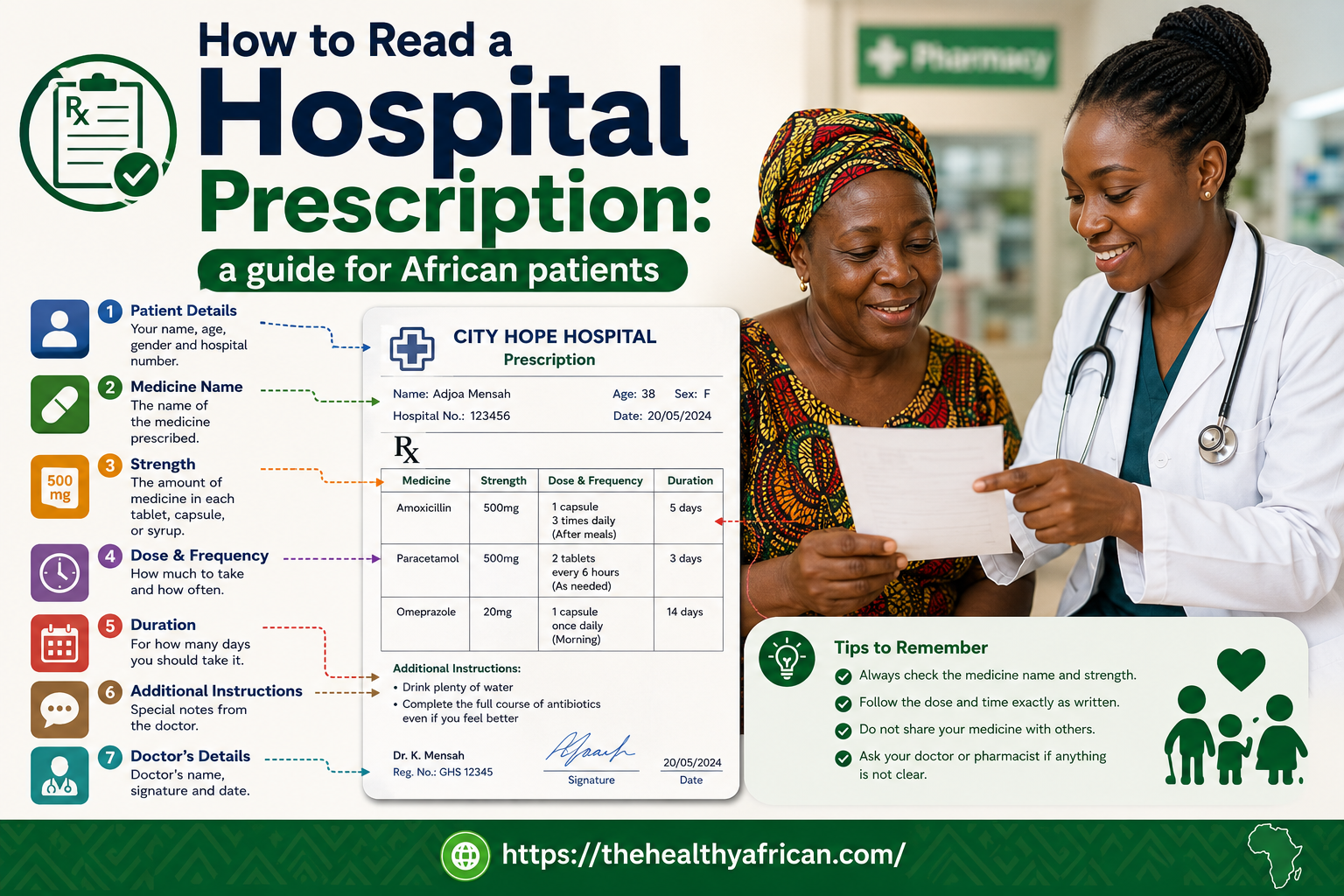
This guide breaks down a hospital prescription into plain language. You do not need a medical degree to use it. You only need to know what to look for and what questions to ask before you leave the pharmacy.
What a valid hospital prescription contains
A properly written hospital prescription is both a legal document and a clinical instruction. It should carry the date it was written, the full name of the patient (and often their age or weight, particularly for children), the name of the medicine, the dose and strength, how often to take it, how long to take it, and the full name, professional qualification, and signature of the prescribing doctor. In practice, many scripts from busy outpatient departments across Nigeria and Kenya are missing one or more of these elements. If your name is absent, or the prescription carries no signature, raise this with the pharmacist before anything is dispensed.
The Rx symbol and prescriber information
You have probably seen the symbol “Rx” stamped at the top of a prescription pad. It comes from the Latin word recipe, meaning “take,” and it signals that a qualified clinician has authorised what follows. Below it, the form should carry the prescriber’s name, their qualification (such as MBBS, MD, or BPharm), and their signature, often accompanied by a hospital stamp. A prescription without a valid signature is not legally recognised in Nigeria or most other African countries. If yours lacks one, return to the consulting room and request it.
Generic name versus brand name
Your doctor may write either the generic name or the brand name of a medicine. The generic name is the international scientific name of the active ingredient, for example, amoxicillin. The brand name is the commercial name a manufacturer assigns to it, for example, Amoxil or Ampiclox. Both refer to the same drug. WHO medicines guidance encourages prescribers to use generic names where possible, partly because generics are cheaper and more reliably available across African health systems. If your pharmacist gives you an unfamiliar brand, ask whether the active ingredient and strength are identical to your previous supply before accepting it.
Understanding the dose and strength
After the drug name, you will see a number paired with a unit. “500 mg” means five hundred milligrams. “250 mg/5 ml” means 250 milligrams in every five millilitres of liquid, which is the standard format for paediatric (children’s) syrups commonly prescribed for malaria and bacterial infections across the region. Do not assume that a higher milligram count means a better medicine. The dose your doctor has written reflects your age, weight, and specific condition. Taking more than prescribed does not speed recovery; it raises the risk of harm.
Decoding frequency abbreviations
This is where most patients encounter problems. Doctors use Latin-derived shorthand to indicate how often a medicine should be taken. The abbreviations below appear on the majority of African hospital prescriptions:
- OD (omni die) — once daily
- BD (bis in die) — twice daily, usually morning and evening
- TDS (ter die sumendum) — three times daily, typically morning, afternoon, and night
- QDS or QID (quater in die) — four times daily, roughly every six hours
- PRN or SOS — as needed, only when symptoms occur, such as pain or fever
- STAT — immediately, for the very first dose
- HS (hora somni) — at bedtime
- AC (ante cibum) — before meals
- PC (post cibum) — after meals
The WHO’s Medication Without Harm initiative identifies incorrect dosing frequency as one of the major drivers of avoidable medication harm worldwide. Taking a BD antibiotic once a day instead of twice may mean the drug never reaches the concentration in your bloodstream needed to clear an infection.
How long should you take the medicine?
African hospital prescriptions, particularly in Nigerian teaching hospitals, often express the duration of treatment as a shorthand fraction:
- x/7 refers to days — “x 5/7” means five days
- x/52 refers to weeks — “x 2/52” means two weeks
- x/12 refers to months — “x 3/12” means three months
If you are unsure about any of these, ask your pharmacist to write the duration in full before you leave the dispensing counter. For antibiotics in particular, completing the full course matters.
Route of administration
The route tells you how the medicine enters your body. PO (per os) means by mouth and is the most common instruction on outpatient scripts. IV stands for intravenous, meaning directly into a vein, and IM stands for intramuscular, meaning injected into the muscle. These two routes are typically carried out by healthcare workers in a clinic or hospital ward, not at home.
Verifying your medicine: the NAFDAC number
For patients in Nigeria, one further step is worth making. Every legitimately registered medicine should carry a National Agency for Food and Drug Administration and Control (NAFDAC) registration number on its packaging. NAFDAC has also introduced a Mobile Authentication Service (MAS) for antimalarials and antibiotics, which allows patients to scratch a panel on the drug pack and verify authenticity by texting the revealed code to a published shortcode. Research published in Frontiers in Pharmacology identifies Nigeria’s MAS as one of the most practical consumer-level tools against falsified medicines in sub-Saharan Africa (verified June 2026). If a package has a blurry or missing registration number, poor print quality, or no visible expiry date, do not use it. Report it to NAFDAC on 0800-162-3322 or at sf.alert@nafdac.gov.ng.
This article is a guide to help you ask better questions at the clinic and pharmacy. It does not replace advice from your doctor or pharmacist. If anything on your prescription is unclear, always verify before you begin treatment.
Frequently asked questions
What does BD mean on a hospital prescription?
BD stands for bis in die, a Latin phrase meaning “twice daily.” Your doctor is asking you to take the medication twice within 24 hours. For most BD medicines, spacing doses roughly 12 hours apart, such as morning and evening, gives the best therapeutic result unless your pharmacist advises a different schedule.
What is the difference between OD and BD?
OD means once daily (omni die) and BD means twice daily (bis in die). They are not interchangeable. Taking a BD antibiotic once a day may mean the drug never reaches the level in your bloodstream needed to clear the infection. These two abbreviations look similar but carry very different instructions.
What if I cannot read my prescription?
Ask your doctor or pharmacist to write the instructions in plain language, or in a language you read more comfortably. Every patient has the right to understand their treatment. Most hospital pharmacies in Nigeria and Kenya will label the dispensed packet with full written instructions if you request this before you leave the counter.
Can I use a prescription written for someone else?
No, and this applies even to close family members. A prescription is tailored to a specific patient based on their weight, age, kidney function, and other medicines they are taking. Using another person’s script can result in the wrong dose or a dangerous drug interaction, even when the underlying condition appears similar.
How do I know if a medicine bought in Nigeria is genuine?
Look for the NAFDAC registration number on the packaging and check that the print is clear and unsmudged. For antimalarials and antibiotics, look for the MAS scratch panel and send the code by SMS to verify authenticity. Always purchase from a licensed pharmacy rather than open markets or roadside vendors. If you suspect a product is counterfeit, report it to NAFDAC on 0800-162-3322 or email sf.alert@nafdac.gov.ng.
Understanding your hospital prescription is the first practical step towards taking your medicines safely and getting the most from your treatment. The next time a doctor hands you a script, take a moment before leaving the consultation room to read it through, identify anything that is unclear, and arrive at the pharmacy counter ready to ask the right questions. For patients managing long-term conditions such as hypertension, diabetes, or HIV, learning the names and exact doses of your regular medicines by heart is a habit that can protect you in an emergency.
** This Article has been Reviewed by Dr. Chimaobi Felix, MBBS
⚕ Medical Disclaimer
This article is for educational and informational purposes only and does not constitute medical advice, diagnosis, or treatment. Always consult a qualified healthcare provider before making any health decisions. The Healthy African is not liable for any actions taken based on the information provided on this site.